Kiln Projects
Groundhog Kiln
The Ralph Howard Phillips kiln was a working "Southern Groundhog" kiln located in Jay Florida.
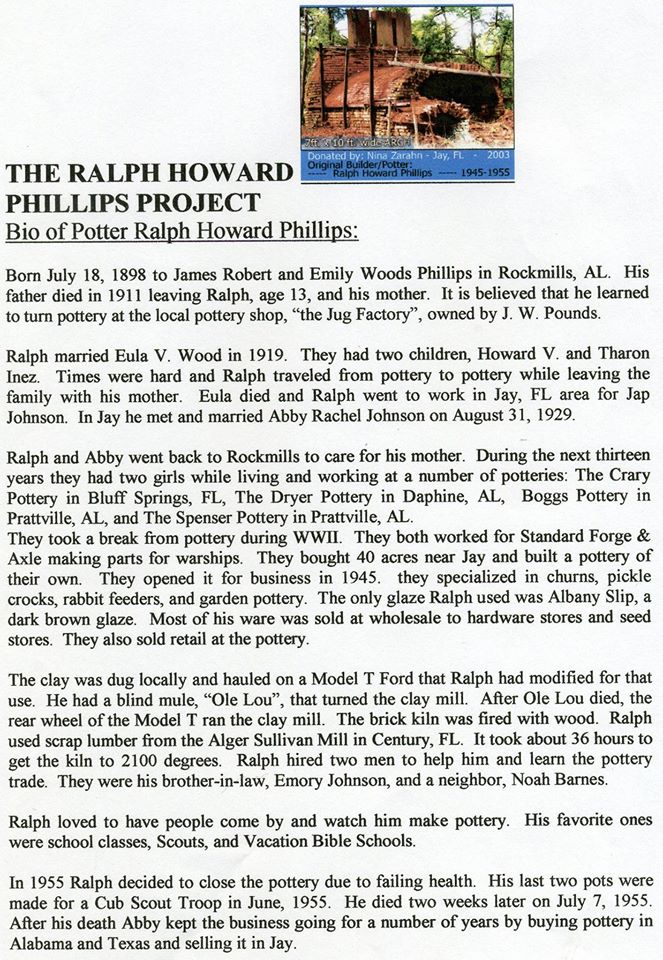 Mr. Phillips built the kiln about 1945. Phillips and his wife, Abby Johnson Phillips, developed a pottery business that used the kiln primarily to produce churns, crocks, rabbit feeders and garden pottery made from local clay with an albany slip applied. The market was also local.
Click to read a short biography of Ralph Howard Phillips.
Mr. Phillips built the kiln about 1945. Phillips and his wife, Abby Johnson Phillips, developed a pottery business that used the kiln primarily to produce churns, crocks, rabbit feeders and garden pottery made from local clay with an albany slip applied. The market was also local.
Click to read a short biography of Ralph Howard Phillips.
Events are below with a timeline for construction and the first firing:
| 2008-02-26 | Reconstruction of the Phillips groundhog kiln was started.
John Rezner  ,
noted potter from Fairhope Alabama, led the construction project. ,
noted potter from Fairhope Alabama, led the construction project.
|
| 2008-03-28 | The crew resumed work on the Groundhog kiln on Sunday and Monday. Work was begun on the arch of the kiln. |
| 2008-04-18 | The long awaited rails arrived for the groundhog kiln. Work resumed Saturday afternoon and all day Sunday. |
| 2009-01-09 | Poles were set for the rain shed and the first layer of clay cast over the arch. A second layer was added the following day. The bricks from the historical Phillips kiln were cleaned and prepared for installation over the firebrick liner. Members also split and stacked firewood for the inaugural firing. |
| 2009-02-12 | Loading the kiln for first firing began. |
| 2009-02-12 | Dedication Ceremony and Inaugural Ignition. Stoking and firing began. |
| 2009-02-15--18 | Firing and stoking continued with crews working 24 hour shifts. The kiln temperature was raised and held to the level needed for clay vitrification and ash-to-glaze transmutation. Wood stoking ended and the kiln was sealed. |
| 2009-02-18--28 | The kiln was allowed to slowly cool. |
| 2009-02-28 | The kiln was opened. The 4th Annual WoodStoke Pottery Festival was held. Chili was served! |
Anagama Kiln
In December 2005, at 7507 Buckeye Road, Holley, Florida the Gulf Coast Kiln Walk Society celebrated the inaugural firing of its newly constructed 32’ wood-fueled Anagama kiln. Among others in attendance were renowned ceramic artists Don Reitz and Brian Harper.
On November 29, 2005 loading commenced in preparation for firing. Then on December 3, the massive Anagama kiln, which holds upwards of 800 pieces, was lit for the first time.
While firing, the kiln requires round-the-clock care and feeding. A team of about 20 work in four- to six- hour shifts adding wood and monitoring the fire which is contained within the kiln and glows so bright it can be seen from nearly half mile away. Workers drop about six cords of wood into the kiln during the weeklong firing process. One cord of wood is 4’ x 4’ x 8’ (neatly stacked) – or about a truckload. Furthermore, a single cord of wood releases the heat equivalent to what is produced by a ton of coal or 200 gallons of fuel oil. This helps the kiln to reach the optimum firing level of 2,400 degrees .
The Anagama is allowed to cool for about a week leading up to the kiln opening ceremony. This is when workshop participants, artists, and the Gulf Coast community catch their first glimpse of the ware inside. It’s difficult to know exactly what they’ll find, except that no two pots will look the same.
Wood-burning kilns produce colors and effects that can’t be achieved any other way. Variables such as airflow, positioning of the pots, type of clay used and, sometimes, pure chance make every piece unique. Everyone is always amazed by the beauty uncovered when the kiln is opened.
Local potters Brenda and Marty Stokes, are the masterminds, project leaders and whip-cracking overseers behind the Anagama project.
Stokes emphasized that this firing event draws on community, as has the process leading up to it. In 2004, for example, the Gulf Coast Kiln Walk Society grounds became a revolving door for artists and local residents interested in the construction of the Anagama kiln.
In addition to the actual event, the presence of Don Reitz and Brian Harper was attraction itself. Brian, former assistant to Don, led the workshop to build the Gulf Coast Kiln Walk Society Anagama. They both attended the workshop and slide presentations and the historic lighting ceremony December 3rd, 2005.
Plans are that the Anagama kiln will be fired roughly once a year. Other projects, e.g. the Phillips groundhog kiln (above), might modify this plan (but it works!). See pictures of other firings (2006, 2008) and videos of the Anagama construction on the media page. These videos are highly recommended! The videos feature the two kilnmasters Reitz and Harper up close, also highly recommended!